
718 Rufino Petit Hotel
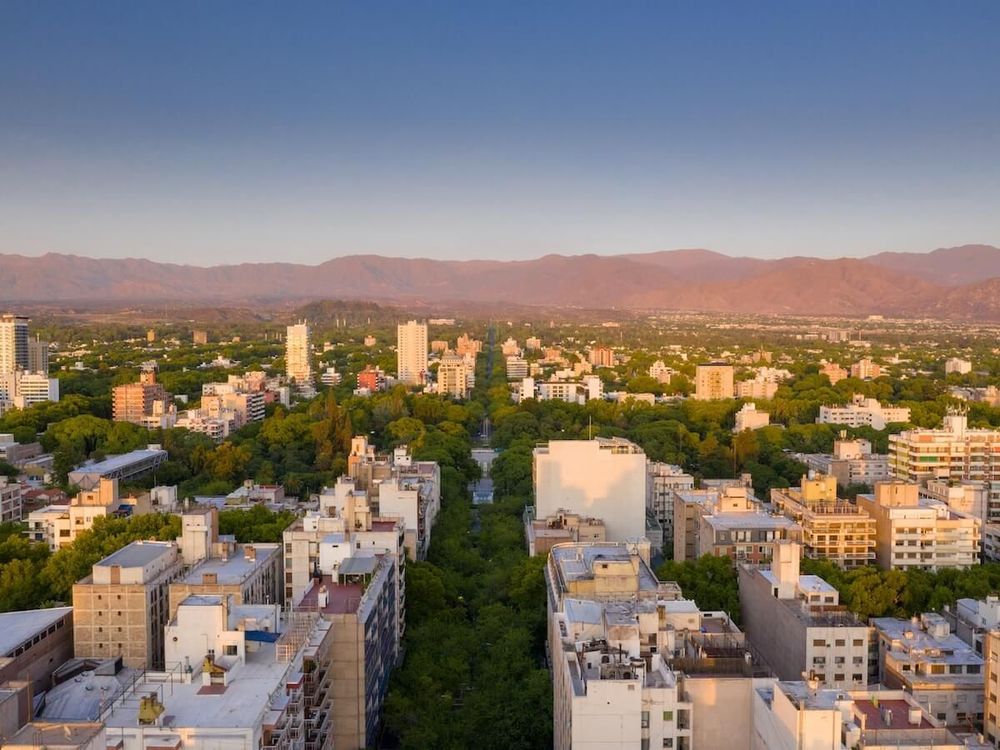

The General San Martín Park was designed in 1896 by the architect Carlos Thays, the renowned French landscape architect; in it the English and French tradition of gardening of the 19th century are combined.
The forest heritage with more than 300 species originating from North America, Asia, Europe and Australia have turned it into a plant universe, full of streets and paths specially built to make your journey more pleasant. Its 400-hectare plant orb was created based on a quality of life criterion, since the afforestation on the west side of the city allows for the correct humidification of the environment. For more than a century, this park has been one of the most important urban green spaces in Argentina, both for its size and for its proximity to the city. Currently it covers 307 cultivated hectares, 17 km. routes and 82 hectares of expansion.
Plaza Independencia is an urban space, located in the City of Mendoza, Argentina. It was inaugurated in 1863. It is located in the center of the city between Patricias Mendocinas, Chile, General Espejo and Rivadavia streets.
A detail to take into account are the natural stone seats on Patricias Mendocinas street, in the sectors of the bus stops designed for passengers or the general public, and which replace the previous concrete ones, having extended their extension . They are continuous and are only interrupted to make room for the lampposts that illuminate the place. The entrance through Patricias Mendocinas street, from the pedestrian street, has a large flower bed with flower beds, and in the center, along its entire length, an extensive fountain with central and lateral water features illuminated in white and light blue, which sequences undulating movements. like the cloth of our Homeland banner.
Located on the old grounds of the General San Martín Railroad freight station, this magnificent park has 14 hectares and 1,200 trees. Located in an important residential area with high housing density and close to the city center, it has become one of the most important green spaces that hundreds of citizens enjoy daily. Among the most attractive sectors is a beautiful lake with ducks that symbolizes the importance of water in this semi-desert area, all of this crowned by a natural grass amphitheater.
This green lung has enormous strategic value for the urban development of the City. Here outdoor, cultural and sports activities organized by the Municipality of the City of Mendoza for recreation and social gathering are carried out permanently.
As of 2010, an important Multidisciplinary Cultural Center called 'Nave Cultural' is created within it.
The Enoteca, located in the Civic Center of Mendoza, is the only existing architectural testimony of the National Viticulture School, which operated between 1897 and 1939 and trained the first winegrowing professionals in Argentina and Latin America.
This School of Viticulture began to function on August 3, 1897 with fifty-two students, who received the title of foremen-administrators of vineyards and wineries.
As of 2002, this old winery has been refunctionalized by the Mendoza Vitivinícola Fund and is the Thematic Center of Wine where activities to promote the vitivinícola activity are carried out throughout the year. The Enoteca values its founding history and is projected as a strategic point of culture and wine tourism.
With the purpose of erecting a commemorative monument of the campaign of the Army of the Andes, during the presidency of Juárez Celman, National Law No. 2270 was issued in 1888.
However, the project did not come to fruition and it was only when the Centenary celebrations were organized that the idea was taken up again and the province issued Law No. 6286 in 1909, which gave rise to the location of the monument.
The sculptural complex, 16 meters high and made of bronze, was cast in the Arsenal de Guerra de la Nación. It is the work of the Uruguayan sculptor Juan M. Ferrari (1874-1916) who, to carry out this work, carried out a meticulous study of the customs of the San Martin era. Previously, he had made two models, under the advice of the expert Francisco Moreno, a member of the national commission that promoted the monument.
It is located in the current 'Cerro de La Gloria', in the Gral. San Martín Park, originally known as 'Cerro del Pilar'; on a stone base brought from the Andes Mountains.
At its base, as a patriotic-symbolic message, a brick belonging to the May Pyramid was placed, which was sent by the National Historical Museum.
In the 1940s, the architect Daniel Ramos Correas remodeled the surroundings of the monument and built a wide access stairway to it, with an offering and plaque on the esplanade before the summit.
The Cerro de la Gloria Monument, its base and its surroundings were declared Cultural Patrimony of the Province of Mendoza by Decree No. 552/98.
A place full of flavors and Mendoza history, come to visit it and discover the corners of this traditional central market.
A street with history: Las Heras Avenue. In its beginnings it was an alley and natural alluvial channel, becoming one of the main streets of the new city after the earthquake, appearing in the plan of the new city in 1872, with the name of Avenida de Circunvalación Norte. It was also known as Calle de las Carretas, Calle del Ferrocarril, Calle de los Inmigrantes and it was also the Boulevard de las Palmeras.
In 1882 it was called Avenida Las Heras and since then it has become one of the main meeting points for Mendoza and visitors. On this artery we find one of my favorite places in Mendoza, the Paseo Mercado Central.
The market offers the products of the Mendoza land: fresh and dry fruits and vegetables, wines, homemade sweets and typical foods and it is a place where tradition left its mark, since there are stalls that are run by the fourth generation of the same family .
A place where you can breathe love for work, tradition, respect for the product and where the vendors know your name and greet you with a smile. Let's go back to the markets!
The Foundation Area is an important urban complex made up of different architectural elements: Pedro del Castillo Square, the Foundation Area Museum, the San Francisco Ruins and the adjacent section of O'Higgins Park. The Foundation Area Square rescues the site where The City was founded on March 2, 1561. The most significant buildings of the old urban area were built around it. Colonial Mendoza was devastated 300 years after its foundation by an earthquake (on March 20, 1861). The Cabildo, located in the sector where the Museum was later established, disappeared as a result of this great earthquake. Later, a slaughterhouse (1877 - 1927) operated on this site, and then a Municipal Fair (1940-1980).
The Museum, a work carried out by the Municipality of Mendoza -initiated and developed during the management of Dr. Víctor Fayad, and inaugurated in February 1993- enables the investigation, protection and dissemination of this urban historical-archaeological heritage that represents the origins of the City. The Foundational Area has an annual calendar of popular events among which 'Anniversary of the Foundation' (March 2) and 'Celestial and White City' (week of May 20-25) stand out. Courses, book presentations and plays such as 'Huellas' (which recreates the foundation of Mendoza) are also held.
Located in the great Mendoza, it bears this name in honor of the founder of the city, on March 2, 1561, Don Pedro del Castillo. In this picturesque square forested with a very varied vegetation brought from Misiones (Argentina), the most diverse variety of Palm trees from the Canary Islands (Spain) and Brazil, you can see in its surroundings the Majolica posters that indicate the important events of the city within the founding area. It was the epicenter of the religious and social life of the city until it was destroyed by an earthquake in 1861. In this square, General San Martín proclaimed the Virgen del Carmen de Cuyo General of the Army and the Flag of the Army of the Andes and the Staff of Command.
After having received various names such as: Plaza de Armas (1562), Plaza Independencia (1810), Plaza de la Constitución, Plaza Vieja and Plaza del Matadero, finally in the 20th century it received its current name. The location is that of the square and the data of the Ministry of Tourism of Mendoza. The location is that of the Plaza, the data of the Ministry of Tourism of Mendoza

...
...


